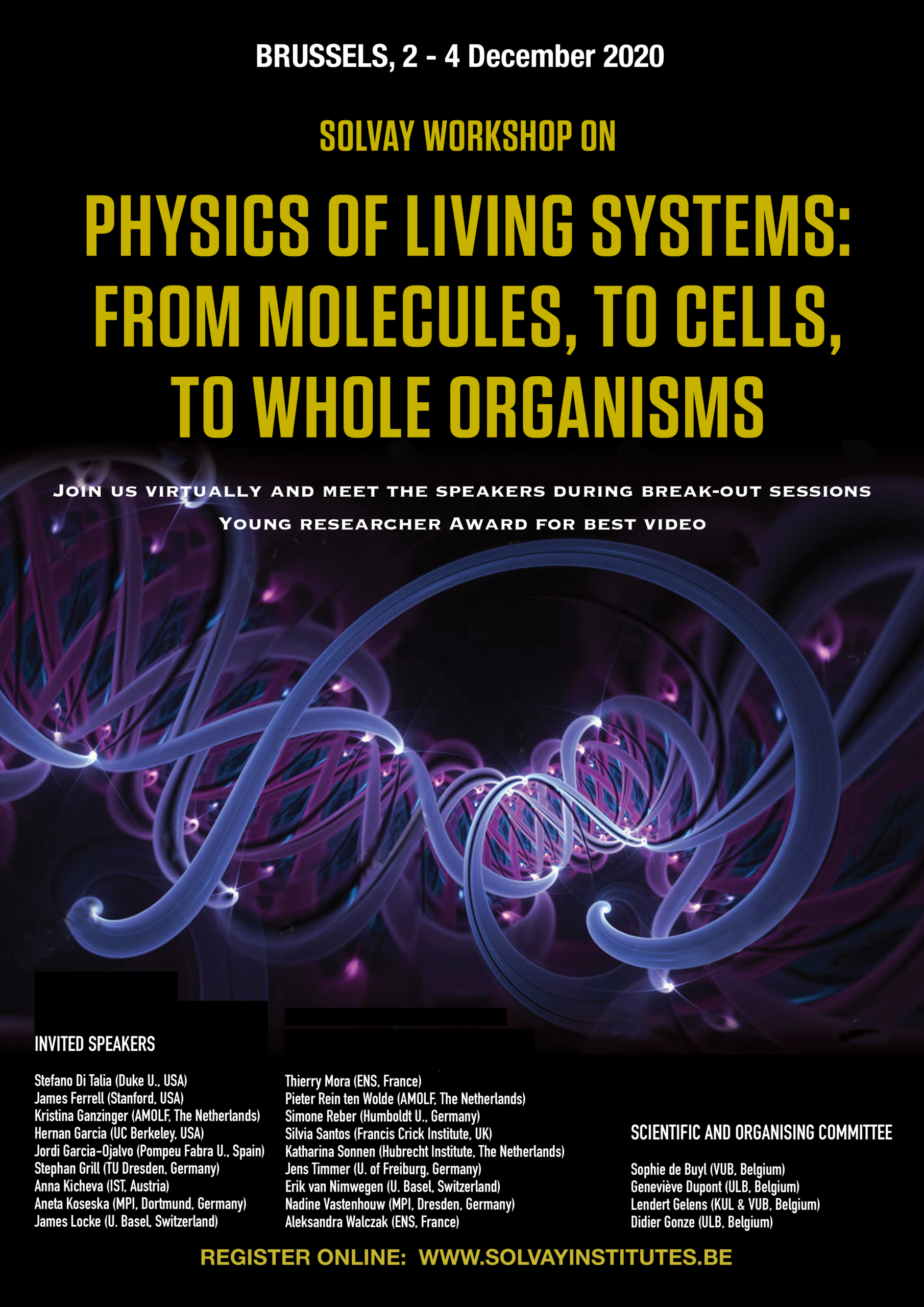
Physics of living systems: from molecules, to cells, to whole organisms
Workshop
Living systems are dynamic and complex at all levels, ranging from the interaction of many molecules in the cell, to the coordinated behavior of many cells in multicellular organisms. Understanding this biological complexity requires an interdisciplinary approach. Therefore, this workshop brings together scientists with various backgrounds to tackle several fundamental questions in biology.
Molecules. The number of different molecules present in each cell is regulated by a large network that integrates metabolism, protein interactions and gene regulatory elements. How do these multiple regulatory mechanisms work in concert and enable cells to make decisions? How do cells deal with the intrinsic stochasticity inherent to small DNA copy number and small numbers of molecules? Do specific regulatory network architectures optimize different physical quantities such as information transmission, energetic costs or dissipation?
Cells. It is known that the number of molecules also strongly depends on the location within the cell. The spatiotemporal organization of molecules in the cytoplasm and in various organelles plays a key role in coordinating cellular behavior, such as division, growth and locomotion. Perhaps one of the most in- triguing open questions is how a cell senses and regulates its own size and shape, and how it controls the number and location of its various organelles. Molecular mechanisms and physical principles underlying cellular organization in general will be explored.
Organisms. Whole organisms rely on the coordinated behavior of many cells to function. How is a developing embryo able to robustly create its body plan based on individual cell properties and cell- cell communication? Different strategies have been selected by different organisms, such as relying on morphogen gradients or using mosaic development to dictate spatial patterning of the embryo. General principles that lie at the heart of embryonic development will be discussed.
Invited Speakers
Stefano Di Talia (Duke U., USA)
James Ferrell (Stanford, USA)
Kristina Ganzinger (AMOLF, The Netherlands)
Hernan Garcia (UC Berkeley, USA)
Jordi Garcia-Ojalvo (Pompeu Fabra U., Spain)
Stephan Grill (TU Dresden, Germany)
Anna Kicheva (IST, Austria)
Aneta Koseska (MPI, Dortmund, Germany)
James Locke (SLCU, U. of Cambridge, UK)
Thierry Mora (ENS, France)
Pieter Rein ten Wolde (AMOLF, The Netherlands)
Simone Reber (Humboldt U., Germany)
Silvia Santos (Francis Crick Institute, UK)
Katharina Sonnen (Hubrecht I., The Netherlands)
Jens Timmer (U. of Freiburg, Germany)
Erik van Nimwegen (U. Basel, Switzerland)
Nadine Vastenhouw (MPI, Dresden, Germany)
Aleksandra Walczak (ENS, France)
Scientific and Organising Committee
Sophie de Buyl (VUB, Belgium)
Geneviève Dupont (ULB, Belgium)
Lendert Gelens (KUL & VUB, Belgium)
Didier Gonze (ULB, Belgium)