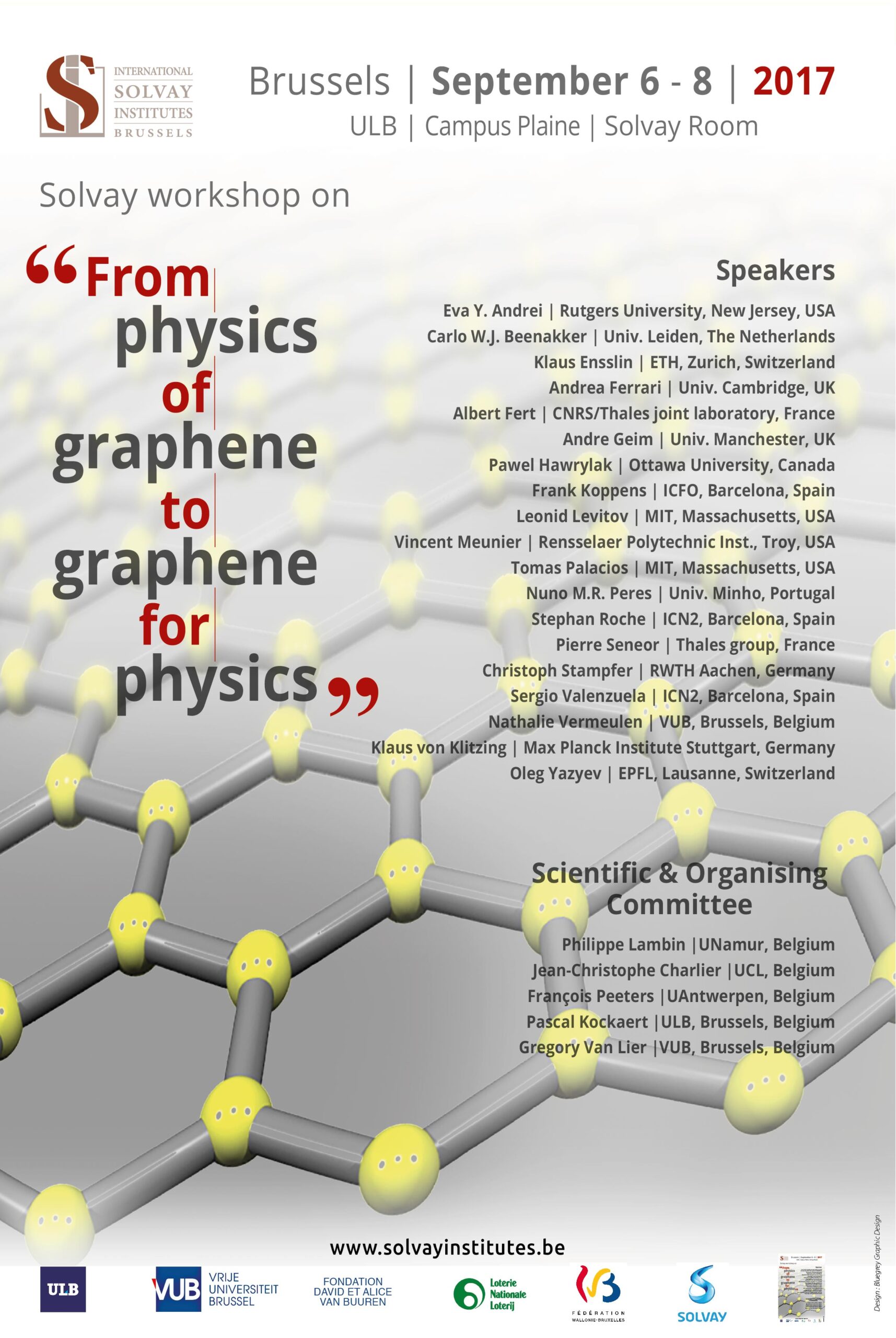
From physics of graphene to graphene for physics
Workshop
Many interesting properties of graphene put this material at the foreground of present day nanosciences. Graphene is mechanically hard, extremely flexible, chemically inert, impermeable to any atom and molecule, optically transparent. It is a zero-gap semiconductor easily made conducting by electrostatic charging, the charge carriers having then a remarkable mobility. The electronic structure of graphene near the Fermi level is remarkable: electrons and holes have a linear energy dispersion versus momentum, much like ultra-relativistic particles in free space. However, they move in a 2D periodic potential with a velocity 300 times smaller than the speed of light. Most of the remarkable properties of graphene come from its band-structure peculiarity: fractional quantum Hall effect, quantum localization, Klein paradox, small optical absorption, high carrier mobility … . Graphene is also an interesting laboratory for the illustration and sometimes verification of predictions of quantum electrodynamics. The Klein paradox, which states that relativistic particles can tunnel across large distances through a barrier potential with 100 percent probability, is one of them. Potential barriers are easily created in graphene by application of an external field making possible the study of Klein paradox. Another, still puzzling effect is the atomic collapse predicted by quantum electrodynamics for high-Z atom. The simplest theory predicts a critical Z for atom stability being the reciprocal of the fine structure constant, about 137. In graphene, the critical Z of a charged defect should be of the order of one, because the fine-structure constant is 300 larger than in conventional electrodynamics. The workshop will be the occasion to review the many interesting and exotic electronic and optical properties of graphene, and to draw a comprehensive picture of the physics that can be learned from graphene, thanks to its analogy with Dirac-Weyl relativistic fermions.
Invited Speakers
Eva Y. Andrei (Rutgers U., New Jersey, USA)
Carlo W.J. Beenakker (U. Leiden, The Netherlands)
Klaus Ensslin (ETH, Zurich, Switzerland)
Andrea Ferrari (U. Cambridge, UK)
Albert Fert (CNRS/Thales joint laboratory, France)
Pawel Hawrylak (uOttawa, Canada)
Frank Koppens (ICFO, Barcelona, Spain)
Leonid Levitov (MIT, Massachusetts, USA)
Vincent Meunier (Rensselaer Polytechnic I.,Troy, USA)
Kostya Novoselov (U. Manchester, UK)
Tomas Palacios (MIT, Massachusetts, USA)
Nuno M.R. Peres (U. Minho, Portugal)
Stephan Roche (ICN2, Barcelona, Spain)
Pierre Seneor (U. Paris-Sud, France)
Jurgen Smet (Max Planck I. Stuttgart, Germany)
Christoph Stampfer (RWTH Aachen, Germany)
Sergio Valenzuela (ICN2, Barcelona, Spain)
Nathalie Vermeulen (VUB, Brussels, Belgium)
Klaus von Klitzing (Max Planck I. Stuttgart, Germany)
Oleg Yazyev (EPFL, Lausanne, Switzerland)
Scientific & Organising Committee
Philippe Lambin (UNamur, Belgium)
Jean-Christophe Charlier (UCL, Belgium)
François Peeters (UAntwerpen, Belgium)
Pascal Kockaert (ULB, Brussels, Belgium)
Gregory Van Lier (VUB, Brussels, Belgium)