2026 Horizons Lectures in Physics
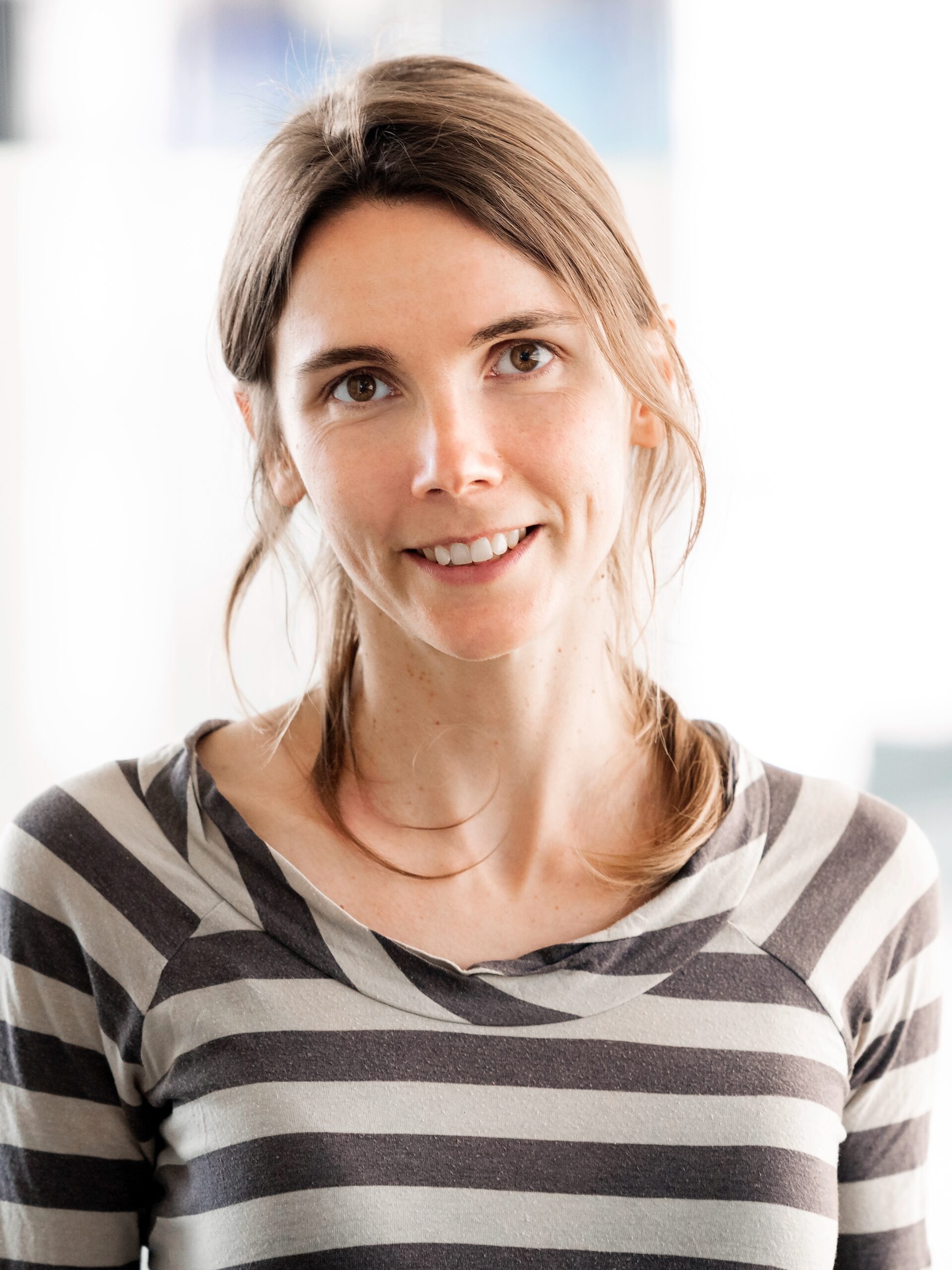
Lauriane Chomaz
Heidelberg University, Germany
Biography
Lauriane Chomaz studied at École Polytechnique in France and received her PhD from École Normale Supérieure in Paris, where she worked with Jean Dalibard on two-dimensional quantum gases with short-range interactions. In April 2015, she joined Francesca Ferlaino’s group in Innsbruck as a postdoctoral researcher, where she discovered the world of strongly magnetic atoms. As part of the Innsbruck team, she contributed to the discovery and exploration of novel quantum states in dipolar gases, including roton excitations, quantum droplets, and supersolidity. In February 2021, she joined the Physics Institute at Heidelberg University as a tenure-track professor, where she established her research group to explore quantum many-body physics with strongly magnetic bosonic and fermionic atoms, with a particular interest in regimes of reduced dimensionality and very low entropy. She became a full professor in October 2024. Beyond physics, she is an enthusiastic outdoorswoman and an avid rock climber.
Exploring New Forms of Quantum Matter with Ultracold Magnetic Atoms
Lecture - Solvay Room on 29 September at 4:00 p.m.
Ultracold atomic gases offer a unique setting in which to explore how collective quantum phenomena emerge from the interactions between many particles. Their interactions, geometry, and dimensionality can be controlled with remarkable precision, making it possible to create and investigate forms of quantum matter that are difficult to access in conventional materials.
In this lecture, I will focus on gases of strongly magnetic atoms, where particles interact not only at short distances but also through long-range and anisotropic dipolar forces. The competition between these interactions produces surprisingly rich physics. One of the key discoveries of the past decade is that quantum fluctuations—usually thought of as small corrections to the average behavior of a system—can qualitatively change its fate, stabilizing states that would otherwise collapse. This mechanism has enabled the realization of self-bound quantum droplets and supersolids, an intriguing form of matter that combines the frictionless flow associated with superfluidity with the spatial order of a crystal.
I will introduce the basic physical mechanisms behind the emergence of these new states of matter and discuss how they can be created, observed, and characterized in experiments. I will then focus on supersolids and on the question of how their simultaneous crystalline and superfluid character reveals itself in their dynamics. Moving beyond the simplest supersolid states, I will then show how the interplay of competing interactions and quantum fluctuations can give rise to a variety of spatially ordered states. The possibility of tuning between these states gives access to structural phase transitions in the quantum regime, whose properties and universality can be explored and compared with those of their classical counterparts. I will conclude by discussing some of the open questions in this rapidly developing field and, more generally, the opportunities that dipolar quantum gases offer for exploring how new phases and collective phenomena emerge in interacting quantum systems.
COFFEE AND TEA WILL BE SERVED AT 3:45 P.M.
Other Lectures and visits
28 September
UAntwerp