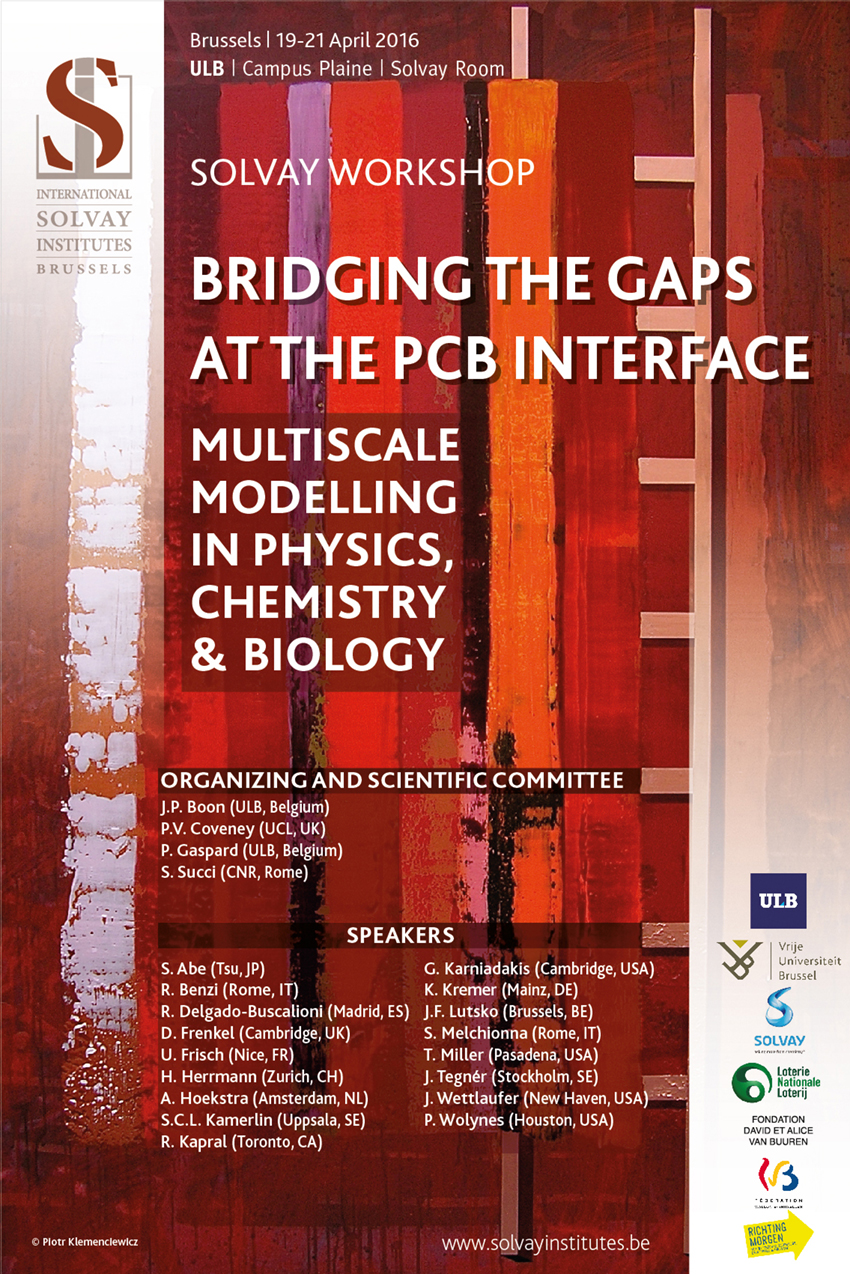
Bridging the gaps at the PCB interface "Multiscale Modelling in Physics, Chemistry and Biology"
Workshop
It is commonly agreed that the most challenging problems in modern science and engineering involve the concurrent and non-linear interaction of multiple phenomena, acting on a broad and disparate spectrum of scales in space and time. It also understood that such phenomena lie at the interface between different disciplines, such as physics, chemistry, material science and biology. The multiscale and multi-level nature of these problems commands a paradigm shift in the way they need to be handled, both conceptually and in terms of the corresponding problem-solving computational tools.
The triple interface between biology, chemistry and physics provides a most fertile ground for these kind of phenomena; the design of environmental friendly catalytic devices or smart-drug delivery devices for nanomedicine purposes, being just two examples in point, where atomic-scale details organize coherently across the hierarchy of scales, all the way up to the macroscopic level which dictates the functional operation of the actual device.
The above phenomena take place far from equilibrium, where the organizing power of non-linearity is fully exposed and universality must be (partially) com-promised with the necessary degree of microscopic (molecular) individualism. Indeed, the ability to sensibly integrate universality and molecular individualism is possibly the most challenging frontier of modern multi-modelling science. Computer technology, a key enabling technology for the quantitative modeling of such complex phenomena across scales, has experienced an extraordinary and relentless growth in both computational speed and memory, along with dramatic cost reductions. At the same time, the last decades have also witnessed tremendous progress in modelling methodologies at all levels of scales, e.g. ab initio MD and QM/MM techniques for atomic and nano-scales, Lattice Boltzmann and Dissipative Particle Dynamics for mesoscales and various gridbased methods for macroscales, culminating with the 2013 Chemistry Nobel Prize for “multiscale modelling of complex chemical system”.
The Solvay Symposium will be centered about the rising multi-modelling paradigm, with special focus on emergent phenomena flourishing at the PCB interface, and should not only help to gain focus on the present state of the art in the field, but, most importantly, also to foster and shape up new cooperative research efforts to advance this exciting forefront of modern science.
There will be an accompanying publication under the same title as a Theme Issue of Proceedings of the Royal Society of London (Series A). We welcome submissions for consideration for publication in this issue from participants in the workshop and the wider scientific community. Submission details will follow shortly.
Invited Speakers
S. Abe (Tsu, JP)
R. Benzi (Rome, IT)
R. Delgado-Buscalioni (Madrid, ES)
D. Frenkel (Cambridge, UK)
U. Frisch (Nice, FR)
H. Herrmann (Zurich, CH)
A. Hoekstra (Amsterdam, NL)
S.C.L. Kamerlin (Uppsala, SE)
R. Kapral (Toronto, CA)
G. Karniadakis (Cambridge, USA)
K. Kremer (Mainz, DE)
J.F. Lutsko (Brussels, BE)
S. Melchionna (Rome, IT)
T. Miller (Pasadena, USA)
J. Tegnér (Stockholm, SE)
J. Wettlaufer (New Haven, USA)
P. Wolynes (Houston, USA)
Scientific & Organising Committee
J.P. Boon (ULB, Belgium)
P.V. Coveney (UCL, UK)
P. Gaspard (ULB, Belgium)
S. Succi (CNR, Rome)