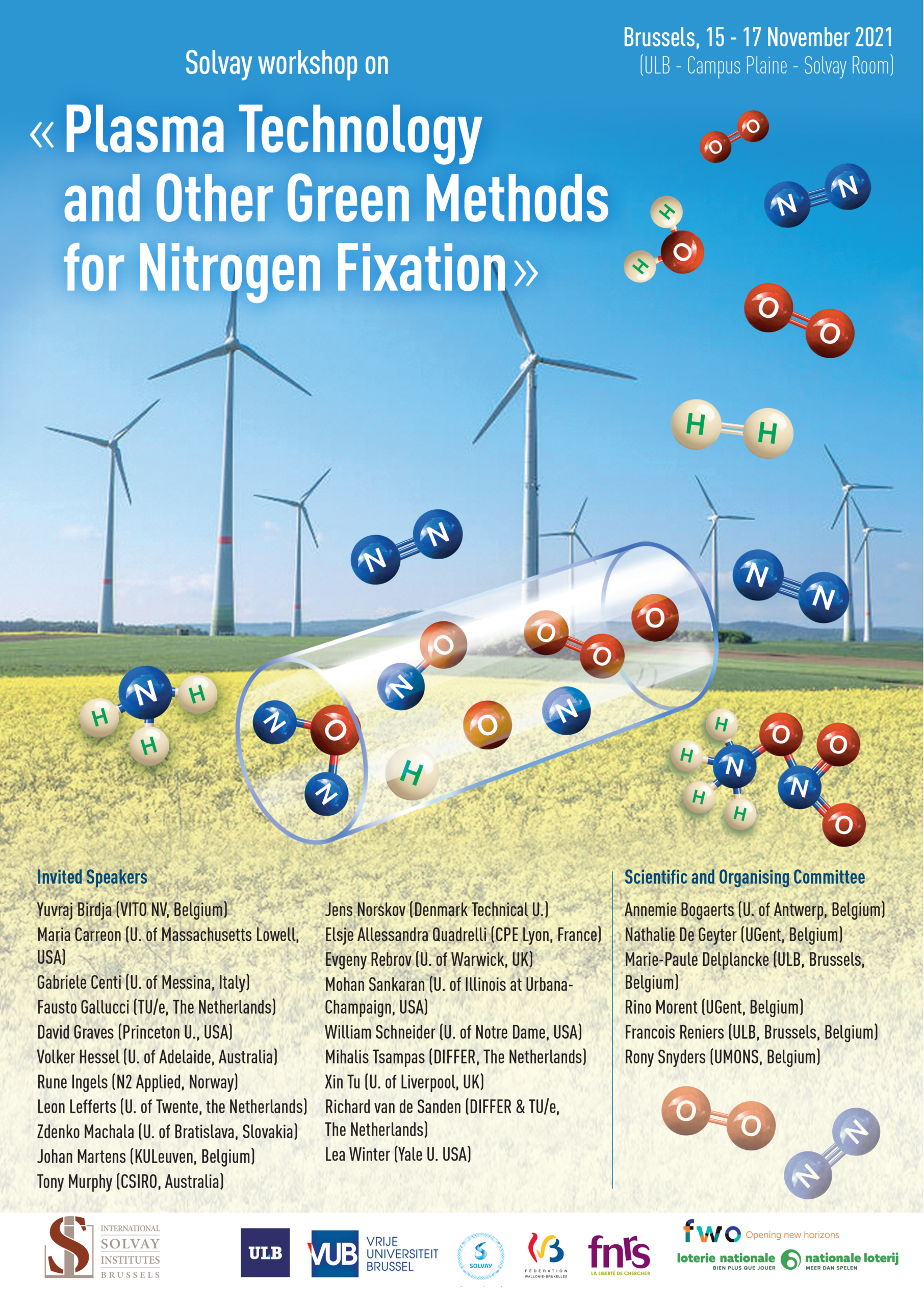
Plasma Technology and Other Green Methods for Nitrogen Fixation
workshop
Nitrogen, the main constituent of the Earth’s atmosphere, is a crucial element in the growth of plants and living organisms. Unfortunately, atmospheric nitrogen (N2) is hardly accessible to most living beings, because of its extremely stable NΞN bond, which demands very high activation energies to break. To become accessible, N2 must thus be chemically bonded to oxygen or hydrogen through a process, which is called N2 fixation. Since the beginning of the 20th century, people have put a lot of effort in developing chemical processes to fix N2. In 1903, Birkeland and Eyde successfully developed thermal arc plasmas to convert air into nitrogen oxides. This process was, however, quickly abandoned by industry due to its low NOx yield and low energy efficiency. In 1908, an alternative N2 fixation technique, known as the Haber-Bosch (H-B) process, was successfully developed, in which NH3 is synthesized from N2 and H2 using iron as a catalyst at relatively high temperature (400-500°C) and high pressure (150-250 bar). The H-B process was commercialized in 1913 and gradually took over the Birkeland-Eyde process, because of its comparatively lower energy consumption and high NH3 production. As a result, the H-B process has been extensively used over the last century. Unfortunately, it consumes almost 2% of the world’s total energy production, emits 300 million metric tons of CO2 and utilizes 3-5% of the total natural gas output. Significant optimization efforts have been done over the last 100 years to reduce the environmental footprint and increase the energy efficiency of the H-B process, resulting today in a modern approach, which almost reaches its theoretical limits. As a result, further improvements in the environmental impact of N2 fixation processes can only be reached by searching for approaches very different from the H-B process.
A lot of research is therefore carried out on novel green methods for N2 fixation that eliminate or minimize the need for fossil fuels, based on heterogeneous catalysis, electro- and photo-catalysis, nitrogenase enzymes and plasma. This workshop will focus on these novel methods, with primary focus on plasma-based N2 fixation, but placing it in the wider context of other green methodologies.
Non-thermal plasma (NTP) indeed appears to be a promising alternative for N2 fixation. It is a partially ionized gas consisting of electrons, ions, excited molecules, ground state molecules, atoms, radicals,… It is of great interest for N2 fixation because of its thermodynamically non-equilibrium nature, as only the electrons have a temperature of thousands of degrees, while the bulk gas remains close to room temperature. The plasma generates highly reactive and energetic plasma species, which can activate the N2 molecules through vibrational-vibrational collisions and electron impact processes. Thus, plasma-based N2 fixation can in principle occur at low reaction temperature and low energy consumption. In addition, plasma can easily switched on/off, making it in principle suitable for using intermittent renewable electricity. This can open new paths for renewable electricity driven chemistry. However, more fundamental research is needed to understand the underlying mechanisms, in order to really exploit this application.
Several types of plasmas have been used in recent years for N2 fixation. Both N2 reduction (into NH3) and oxidation (into NOx) are of interest. NH3 synthesis is mainly carried out in dielectric barrier discharges (DBDs) by plasma catalysis, while NOx synthesis has been investigated in several types of plasmas, including DBD, gliding arc, and microwave plasmas. However, it is not yet clear which plasma type is the most promising. Furthermore, a lot of fundamental research is needed to improve the conversion and energy efficiency of the process in the various plasma types, as well as to design catalysts most suitable for the plasma conditions. This fundamental insight can be obtained by plasma diagnostics experiments and computer modeling. In addition, a lot of insight can be gained from other catalytic approaches, including heterogeneous catalysis, electro- and photo-catalysis, to design the best types of catalysts. Therefore, this workshop also includes speakers from heterogeneous, electro- and photocatalysis, also to place plasma (catalysis) in a broader perspective.
Invited Speakers
Yuvraj Birdja (VITO NV, Belgium)
Maria Carreon (U. of Massachusetts Lowell, USA)
Gabriele Centi (U. of Messina, Italy)
Fausto Gallucci (TU/e, The Netherlands)
David Graves (Princeton U., USA)
Volker Hessel (U. of Adelaide, Australia)
Rune Ingels (N2 Applied, Norway)
Leon Lefferts (U. of Twente, the Netherlands)
Zdenko Machala (U. of Bratislava, Slovakia)
Johan Martens (KULeuven, Belgium)
Tony Murphy (CSIRO, Australia)
Jens Norskov (Denmark Technical U.)
Elsje Allessandra Quadrelli (CPE Lyon, France)
Evgeny Rebrov (U. of Warwick, UK)
Mohan Sankaran (U. of Illinois at Urbana-Champaign, USA)
William Schneider (U. of Notre Dame, USA)
Mihalis Tsampas (DIFFER, The Netherlands)
Xin Tu (U. of Liverpool, UK)
Richard van de Sanden (DIFFER & TU/e, The Netherlands)
Lea Winter (Yale U. USA )
Scientific and Organising Committee
Annemie Bogaerts (U. of Antwerp, Belgium)
Nathalie De Geyter (UGent, Belgium)
Marie-Paule Delplancke (ULB, Brussels, Belgium)
Rino Morent (UGent, Belgium)
Francois Reniers (ULB, Brussels, Belgium)
Rony Snyders (UMONS, Belgium)